
One citizen, one vote. It’s a simple concept, and it has served us well throughout our state’s existence. South Dakota has been a trailblazer for democracy, from citizen-initiated measures to citizen-initiated constitutional amendments.
But at times, our state has fallen prey to legislation tailored to appeal to cheap political points and fearmongering. And at times, lawsuits have forced the state to improve access to voter registration availability.
South Dakota has new requirements for voter registration, and if you fail to complete them, you will be registered as a “federal-only” voter and lose your right to vote in state and local elections.
Despite warnings from the League of Women Voters and the ACLU of South Dakota, a bill requiring documentary proof of citizenship for voter registration – South Dakota’s version of the SAVE Act – passed through the state legislature at a rapid pace earlier this year after its initial defeat in Senate State Affairs. We asked Gov. Larry Rhoden to issue a veto, but he signed it, and the law took effect immediately. Implementation of the law has been flawed, and recently, pressure from a federal lawsuit forced the state to backpedal on the process for notification and curing federal-only voter status.
Since these new requirements have been put in place by the state legislature, election officials have been sending automatically generated letters to voters with inaccurate information about their voter registration status as “federal only,” with no instructions that tell voters how to fix it.
After the implementation of South Dakota’s SAVE Act in March, the phone calls and emails started. Just like we warned, South Dakotans who were newly registered voters were surprised to find out they were barred from voting in state and local elections during a historic gubernatorial primary election and municipal election in Sioux Falls. U.S. citizens who were eligible South Dakota voters were quietly classified as "federal-only" voters because of the overly burdensome documentary proof of citizenship requirement.
What's more, every voter who failed to provide documentary proof of citizenship during voter registration had been receiving an auto-generated letter from the state informing them that they were ineligible to vote in state and local elections because they registered to vote using a commercial mail forwarding service or P.O. box — even though it wasn't true. Further, the letter did not include any instructions for how voters could fix their registration to allow them to vote in future state and local elections.
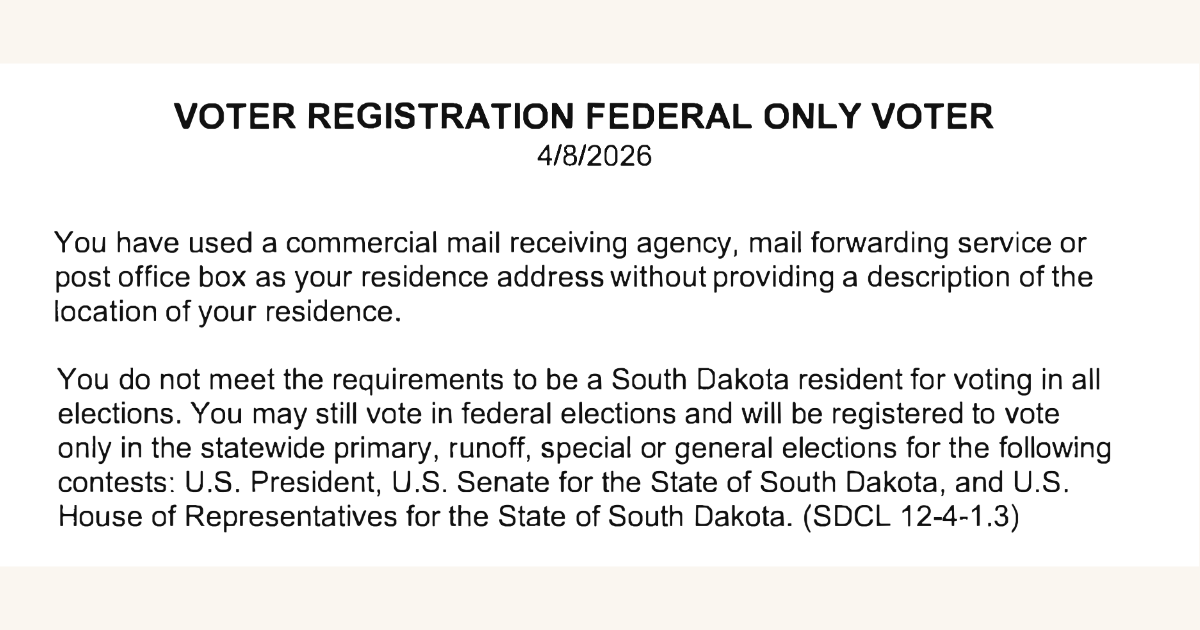
The inaccurate message voter registration applicants would receive if proof of citizenship wasn't provided
In response to this, the League of Women Voters submitted a petition in June to the State Board of Elections requesting them to use their authority to generate administrative rules to resolve the erroneous notification letter, among other improvements to the implementation of South Dakota’s SAVE Act. This petition was supported by testimony from the ACLU of South Dakota, NARF (Native American Rights Fund), the Network Against Family and Sexual Violence, and Disability Rights South Dakota. The State Board of Elections stonewalled advocates and declined to enter into administrative rulemaking using a narrow procedural dodge.
What options were voting rights advocacy organizations left with? Our charge is to protect and expand access to voting for all eligible voters, and we have been watching our neighbors, family and friends lose their right to have a say in elections closest to home. Our numerous attempts to collaboratively resolve the issue were ignored. So, we took the state to court, and the Secretary of State updated their guidance and notification letters directly in response to judicial pressure.
Our work isn't over just because the state addressed one of the issues that landed them in court. We’re still asking the state to remove the in-person presentation requirement for state-issued and tribal IDs during voter registration and to accept photocopies of these documents, allowing voters to register by mail or through voter registration drives—especially since photocopies of other documents, such as birth certificates and passports, are already accepted. Next January, we’ll lobby the state legislature to repeal other barriers to voter registration and voting.
We deserve a state government that operates in service of democracy. Our work will continue in the state legislature, at the state board of elections, and in courts until all barriers to the ballot are eliminated.
A version of this article also appeared in The Dakota Scout.
Ready to take action? Follow the ACLU of South Dakota on social media and subscribe to our email list to stay up to date on the latest ways to take action with us and defend our civil liberties.