
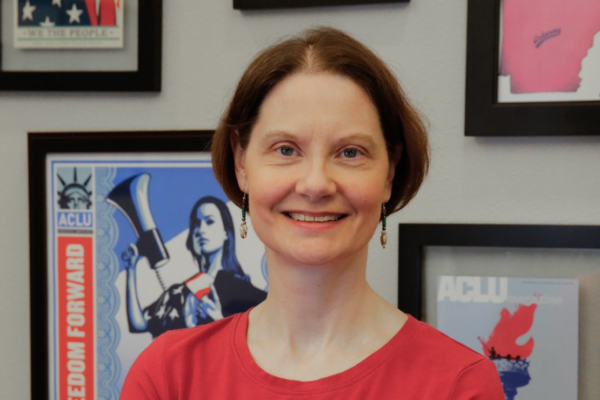
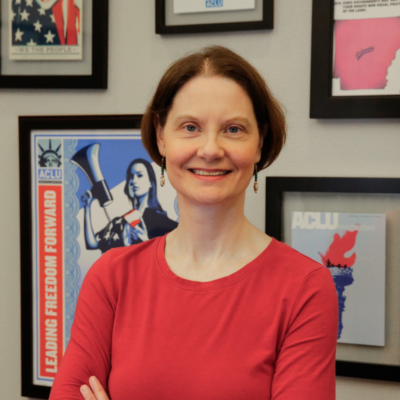
Name: Darcie Rives-East
Pronouns: She/her
Position: Special Assistant to the Executive Director
Hometown: Omaha, Nebraska
For Darcie Rives-East, the fight for civil liberties has long been rooted in a belief that the ideals at the heart of our nation’s founding documents should extend to everyone.
Originally from Omaha, Nebraska, Darcie spent many years as a professor of English at Augustana University in Sioux Falls, where she used her teaching, research, and administrative work to elevate marginalized voices and encourage students to think critically about equality, justice, and the meaning of “We the People.”
Now, as Special Assistant to the Executive Director at the ACLU of South Dakota, she is bringing that same commitment to a new role, supporting the staff and work dedicated to protecting and advancing civil liberties throughout the region.
Darcie’s passion for the ACLU began in high school, when she learned about the organization’s defense of student journalists and their First Amendment rights. That early appreciation has grown throughout her career, particularly as she witnessed increasing challenges to academic freedom, free expression, and the right to access information.
As an avid reader and lifelong fan of detective fiction, particularly the stories of Sherlock Holmes, Darcie brings curiosity, thoughtfulness, and a deep appreciation for the power of stories to everything she does.
Tell us a little bit about yourself. What do you do for a living/where do you go to school?
I am currently the Special Assistant to the Executive Director of the ACLU of South Dakota, North Dakota, and Wyoming, and I am thoroughly enjoying both my new career and my colleagues. For many years, I was a Professor of English at Augustana University in Sioux Falls. Throughout my time in higher education, I advocated for civil rights by making visible the struggles for equality and justice through my teaching, research, and administrative work. In my American literature courses, I encouraged students to consider how the Constitution and the Declaration of Independence articulate admirable ideals in the phrase “We the People,” while recognizing that those ideals have not always been realized for everyone in this nation.
I loved being an educator; however, given the unprecedented challenges to civil liberties in recent years, particularly for marginalized communities, I felt called to serve an organization like the ACLU that works every day to protect and advance those rights. I see my current role as supporting the Executive Director and chapter staff in their efforts to defend and expand the civil liberties guaranteed by our founding documents throughout the tri-state region.
I am originally from Omaha, Nebraska; I graduated from Grinnell College with an English degree in 1996, studied abroad at Curtain University in Perth, Western Australia for a year, and then came back home to earn my M.A. (1999) and Ph.D. (2006) in American Literature from the University of Nebraska-Lincoln.
What do you like to do in your spare time? Family/pets?
I live in Sioux Falls with my husband and our two cats, Lottie and Gertie. My husband and I enjoy hiking, travelling, and antiquing. I also practice yoga, and I love to read and listen to audiobooks, podcasts, and music. My favorite genres have always been speculative fiction (sci fi, horror, gothic) and detective fiction, particularly those written by women (which was the focus of much of my teaching and research). My interest in detective fiction began with reading the original Sherlock Holmes stories when I was 11 or 12. I have since been a Holmes superfan, and I particularly enjoy how different writers, as well as series and film producers, have reinterpreted the character over time. That interest overlaps with the fact that I am a total Anglophile, despite specializing in American literature and history. I’ve traveled to London several times (London is my favorite city), and I avidly consume British literature, television, and comedy: anything Jane Austen, as well as Doctor Who and Monty Python, just to name a few.
When did you first hear about the ACLU?
I first became aware of the ACLU in high school, when I took journalism classes and wrote for our school newspaper. As student journalists, we learned how school administrators and parents across the country often attempted to censor student speech or prevent reporting on issues they did not want to publicize. I learned that the ACLU had repeatedly defended the First Amendment rights of students, particularly student journalists, and argued that the freedoms guaranteed by the Constitution do not stop at the schoolhouse door.
That idea resonated with me because, even as a teenager, I believed our journalism served an important purpose. Reporting on administrative decisions and how tax dollars were being used helped inform our fellow students, and I never thought our voices mattered less simply because we were sixteen or seventeen years old.
Later, as an educator, I saw the ACLU continue to defend civil liberties in the face of challenges to academic freedom, from book bans to efforts to restrict what instructors can teach. Those experiences only increased my appreciation for the organization’s work and its role in protecting fundamental rights.
Which of the ACLU’s issue areas are you particularly passionate about and why?
I honestly don’t know that I could choose just one issue since all civil liberties are interconnected and each affects the others. However, I want to highlight why the current issue of voting rights is so important.
In my American literature survey, I always taught W.E.B. Du Bois’s The Souls of Black Folk (1903), particularly his response to Booker T. Washington’s famous “Atlanta Compromise” address, in which Washington advocated economic advancement for African Americans over the attainment of civil rights. Du Bois argued the opposite: without civil rights, and especially without the franchise, Black Americans would never achieve equality.
As I underscored to my students, Du Bois understood how powerful voting rights are. If they were not, there would not be such persistent efforts to disenfranchise African Americans and other marginalized groups. I often pointed out that this remains true today, whether in challenges to voting protections (specifically, to the Voting Rights Act of 1964), redistricting disputes, or attempts to restrict access to the ballot. We are even hearing rumblings in some quarters about rescinding women’s right to vote, a hard-won victory that my own grandmother helped secure. For that reason, the work of the National ACLU and the ACLU of South Dakota, North Dakota, and Wyoming to ensure equal access to the franchise is especially important right now.
As Du Bois argued, rights must be fought for; no one simply gives them away. Responding to Washington’s suggestion that African Americans should “set aside” civil rights in favor of economic progress, Du Bois captured the attitude of the dominant culture with this devastating observation: “If that is all you and your race ask, take it.”
What is your favorite way to get involved in your community?
My community involvement over the past twenty-five years has largely been through education and through uplifting and centering the voices of marginalized people in my literature courses. I wanted students, many of whom came from backgrounds of relative privilege, to understand that not everyone has access to the opportunities they may take for granted, to consider why those inequities exist, and how both individuals and society suffer when some people are excluded from full participation. Just as importantly, I wanted students from vulnerable and historically marginalized groups to feel seen, heard, and valued. My hope was that they would know their experiences mattered and that they could achieve their full potential.
Why do you think it’s important for people to be involved in their communities?
It may be cliché to say that “it takes a village,” but I believe it really does take all of us working together to create better conditions for everyone. That work can take many forms, but responsibility for building a stronger and more vibrant community belongs to all of us. In an age when social media often isolates and fragments us, it is more important than ever to recognize that our fates are intertwined.
Legislation that adversely affects people who seem different from you does not mean you will be protected from its consequences. We have seen this in South Dakota, where many U.S. citizens have found themselves removed from voter rolls or designated as “federal-only” voters because of laws requiring additional proof of citizenship. Any attack on civil liberties is ultimately an attack on all of us, not just a particular group.
That is why I believe protecting civil liberties requires broad community engagement and vigilance. As Du Bois argued, rights must be continuously defended; they are rarely given freely. The well-being of any one group is connected to the well-being of everyone.
How do you plan on using the work you do at the ACLU to advance civil rights and civil liberties for all South Dakotans?
My role is to support, assist, and help organize the important work the Executive Director and chapter staff are doing to promote and safeguard civil liberties throughout our region. Behind-the-scenes work matters because it frees staff to focus on the civil liberties challenges facing our states and the strategies needed to address them.
Just as importantly, the chapter’s work must be communicated clearly and effectively across teams so that staff can be as responsive, collaborative, and efficient as possible. My goal is to handle many of the operational and organizational mechanics that keep the chapter running smoothly, allowing staff to focus their energy on advancing the ACLU’s mission.
Do you consider yourself a changemaker? Why?
I don’t consider myself a changemaker, but, rather, as someone who supports and assists them, be they ACLU staff or my former students.
Do you have any advice for someone who might be interested in getting more politically involved in their community?
My advice is to realize that serving can come in many different forms; perhaps you are already serving your community—you just don’t see it that way. Consider how your daily job or actions help others, and brainstorm how you could improve or better those actions to reach more people or add to your interactions with your community.
Which of the Constitution’s amendments are most important to you and why?
The most important Constitutional amendment to me is the First Amendment, which protects people from being punished by the government for their speech. The fact that many of the voices, texts, and ideas I taught and researched are now being challenged or silenced on university campuses through government pressure, including threats to withhold funding, is incredibly troubling. I never thought I would see that happen in my lifetime.
Education has always been important to me, both as a student and as an instructor. We cannot have a truly meaningful education if we refuse to confront uncomfortable truths about our nation. There is no way to make a country stronger by blinding ourselves to its problems. For that reason, I find book bans and restrictions on what can be taught chilling. The free exchange of ideas, information, and debate is essential to a healthy society. History repeatedly shows that governments that restrict free expression are, to say the least, less vibrant and resilient than those that protect it.
One poem I always enjoyed teaching was Langston Hughes’s “Let America Be America Again.” I continue to find it relevant, not only because of its response to recurring claims about returning America to a supposedly better past, but because Hughes ultimately offers an optimistic vision. He argues that the United States was founded on powerful ideals, including equality and the rights to life, liberty, and the pursuit of happiness, but that the nation has failed its citizens in realizing them.
Hughes writes that, as an African American man, “America never was America to me,” yet the poem is not cynical. Instead, it asks what America could become if those founding ideals were truly extended to everyone. The poem reminds us that our strength lies not in excluding people or limiting voices, but in embracing our differences and ensuring that everyone can participate fully in our shared civic life.
What are you most looking forward to as a new member of the ACLU’s staff in South Dakota?
I am looking forward to contributing to what will hopefully be the better future envisioned by Hughes. It is going to require overcoming discouragement, and it will demand long, difficult, and consistent work from organizations like the ACLU and everyday citizens to protect and put into action for “all the people” the ideals our nation was founded on. But, it will be worth it.